
N-1 criterion
What is the N-1 criterion and its place in the electricity market?

What is the N-1 Criterion?
The N-1 criterion is a fundamental reliability rule in power systems.
The electricity system must withstand the loss of any single major component (like a transmission line, generator, or transformer) without causing a widespread failure or blackout.
Essentially, the system is planned and operated so that one failure (contingency) does not compromise overall stability.
Preventive and Curative N-1 Criterion
Grid operators can handle the N-1 criterion in two ways:
Preventive - The potential contingency (N-1) is taken into account in advance and included in the security assessment.
Curative - Measures are initiated after the failure has happened. It relies on the capacity of a line to support a higher current for a short period before the line overheats and melts. The contingency is taken into account in the security assessment, assuming measures will take place (i.e. next 1’ to 15’ )
Because the curative N-1 criterion only requires the system to be secure after a contingency has actually occurred, it allows system operators to run the grid closer to its physical limits in normal conditions than the preventive N-1 criterion, which must reserve capacity in advance for all credible outages.
The measures used to solve congestion can be implemented through changes to the setpoint of power plants or by utilizing grid-related measures, such as altering the topology (e.g., changing busbars) or adjusting the tap positions of a Phase-Shift Transformer (PST).
Real-life examples of the N-1 criterion's impact on energy markets
The N-1 principle is not something that only stays in the control room, but can have a tangible impact on the electricity markets. A few examples below.
Europe - Flow-Based Market Coupling: In most European markets, the capacity available for transfer from one bidding zone to another (often equivalent to country to country, except for Denmark, Norway, Sweden, and Italy) is calculated according to the Flow-Based principle. Under the flow-based capacity calculation, transmission system operators will provide a set of Critical Network Elements (CNEs), which are the lines of the system, paired with a Contingency (N-1), often lines, but could theoretically be generators or grid elements.
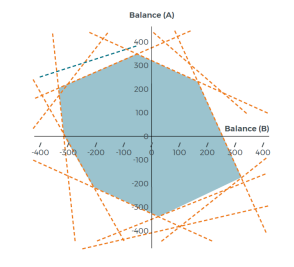
Those CNECs will shape the Flow-Based domain, delimiting available capacity which can be traded between bidding zones. Flow-based market data
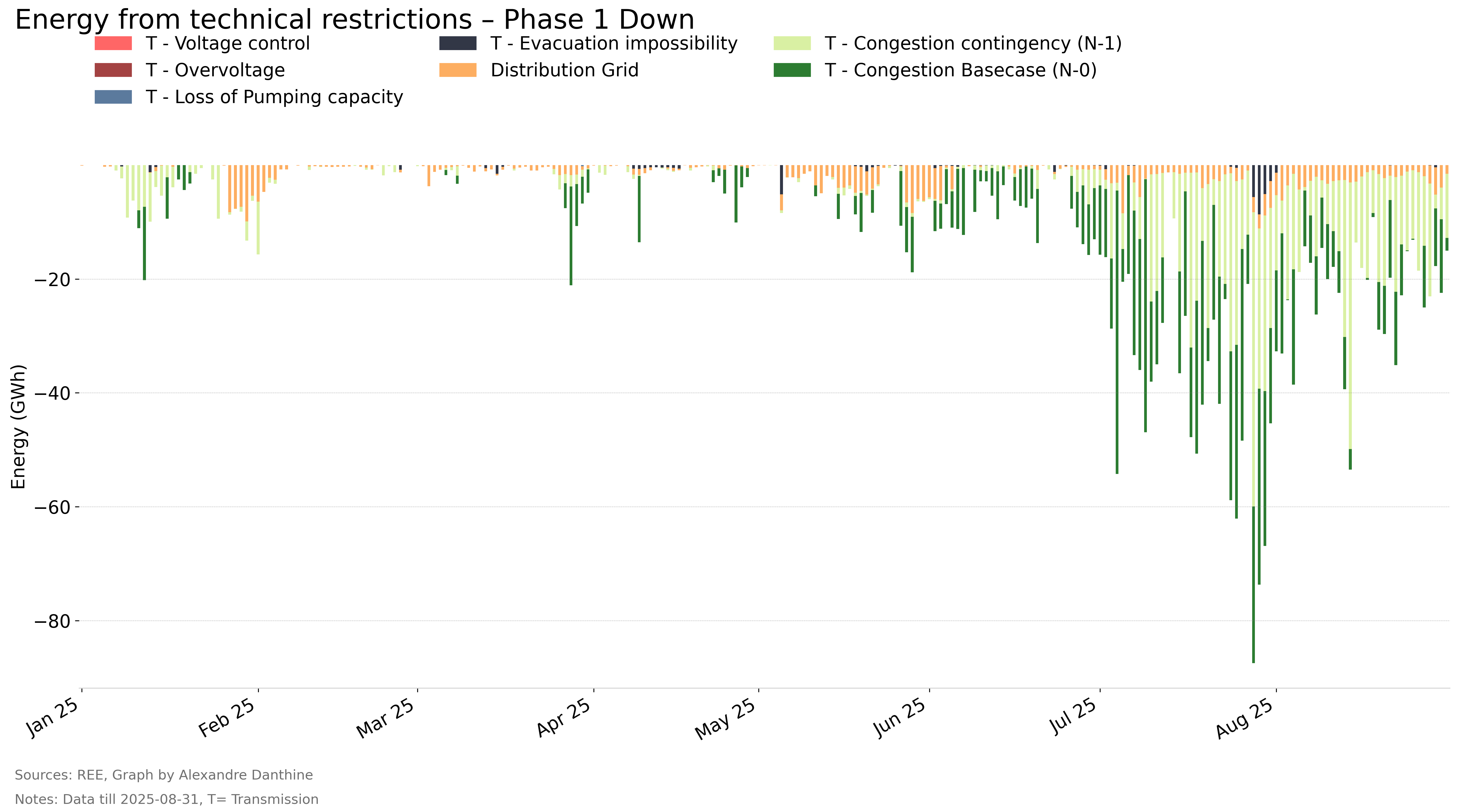
Illustrative Flow-Based domain in two dimensions Spain - Spain’s Technical Constraints: Spain operates a single national bidding zone, so internal network bottlenecks are managed through a special technical restrictions process after the day-ahead market clears. The N-1 criterion plays a key role: after the market results are known, the Spanish TSO (REE) runs additional security analyses (including contingencies).
Although the process is not transparent, we can still observe the types of actions used to solve Basecase or Contingency (N-1) cases, as shown in the graph below (see full article here).
Spain - Sistema de Reducción Automática de Potencia (SRAP): The SRAP is an implementation of the concept of curative remedial actions in the market. As shown above, curtailment is a growing trend in the Spanish electricity market. The SRAP is a mechanism that allows generators to qualify for use in the event of a contingency, serving as a curative remedial action. The mechanism is not remunerated, but generators will be less likely to be curtailed in the first place if they qualify for this mechanism.
Details about the process
As grid bottlenecks become the defining brake on the energy transition, the tools we use to manage them will inevitably move closer to market design. This can be achieved through several mechanisms, such as an after-day-ahead “market” defined by the TSO (e.g., Technical Restrictions in Spain), reform of grid fees to make them locational (e.g., TURPE in France), allowing intraday bids to be used for grid purposes (e.g., GOPACS in the Netherlands), …
What other market design changes do you see coming in the next couple of years to make the electricity market closer to its physical reality?